The unBalanced ecoLOGist: On the Silk Road

Silk Road

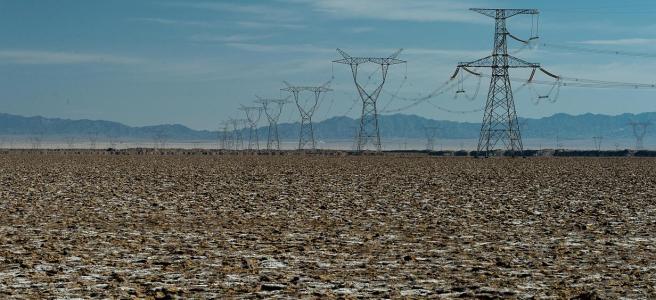
 The 千里1 concrete ribbon slashes the Gobi,

a stale cliché whose 皕公尺2 pullouts double as rest stops sans picnic tables,
but where still-damp tissues mound amply in crevices,

white cumuli cocooning empty bottles tossed haphazardly
by the wind fanning the coals of a smoldering ashcan,

while the selfsame wind,
on the steel strings crossing the ranks of high-voltage towers,
strums a dirge for the lost camel trains.

tibet-4-5-panos-20160914-ame

15/16 September 2016
Poem and photographs © Aaron M. Ellison, all rights reserved


1Read: qiān lĭ (idiomatically: a long distance, lit: 1000 miles or 500 km)
2Read: bì gōng chĭ (200 meters)

Dispatches from Abroad: Foraging Across the Tibetan Plateau

The last couple of days we took a break from exploring treelines to cross the high cold desert along the Silk Road between the once-oases but now thriving cities Dulan and Ge’ermu (a.k.a. Golmud). This 500-km stretch of the Xining-to-Llhasa highway provided incredible views of geology-in-the-raw, and today’s day-trip from Ge’ermu south to the Kunlun Pass added camel trains, huge herds of sheep, a glacier field, and a railroad built atop permafrost.

I’ll get to the sights later. The really fascinating part of the last two days was the foraging for wild foods in a desert that, in the main, gets < 100 mm, and in many places, < 50 mm of rainfall a year. René Redzepi could have a lot of fun here!

Continue reading “Dispatches from Abroad: Foraging Across the Tibetan Plateau”

The unBalanced ecoLOGist: All Juniper All the Time, up to 4200 m a.s.l.

The morning, not surprisingly for a dry desert at 3200 m, dawned bright and blue. Apparently the average 200 mm of annual rainfall here all falls during the monsoon season of June-July (into August). The rest of the time it’s dry dry dry.

I was awakened by a trumpet (recorded or live, I couldn’t tell) playing Reveille at about 05:00 to awaken the high school students for their morning calisthenics.

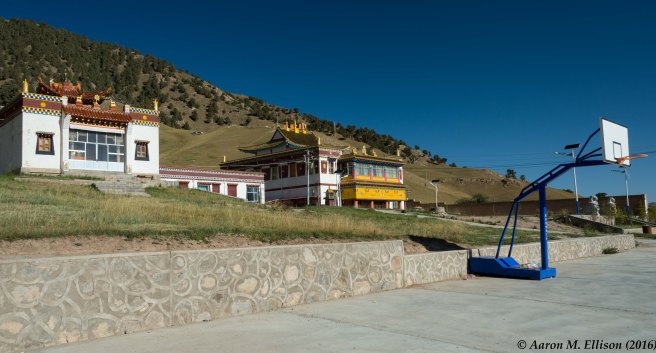
After a quick breakfast of steamed buns, boiled eggs, and fried dough, we set off for a short drive to a nearby valley; the road terminated at a Tibetan Buddhist monastery, where apparently the monks enjoy basketball.

tibet-3-20160912-ame-8130
The Qu ri gang monastery at the entry to the Qu ri gang valley, 30 minutes outside of Dulan city.

We parked the car just outside the court, and started our walk up the valley to explore the junipers (Juniperus przewalski) treeline.

tibet-3-20160912-ame-8205
Juniper is the only tree that grows here, and it reaches treeline at varying elevations depending on temperature and moisture availability. This view is looking towards the north.

Continue reading “The unBalanced ecoLOGist: All Juniper All the Time, up to 4200 m a.s.l.”

The unBalanced ecoLOGogist: Climbing onto the Roof of the World

Early Saturday morning, Eryuan Liang and I flew from Beijing to Xining, the capital of Qinghai Province, which is the province to the east of Tibet. Qinghai and Tibet together span the Tibetan Plateau, but it’s much easier to travel into and around Qinghai. Even for Chinese scientists like Eryuan, who is a member of the Chinese Academy of Sciences’ Institute for Tibetan Plateau Research, which itself has a branch campus in Lhasa, it is far easier to do research in Qinghai than it is to do research in Tibet. And here be treelines, which are the focus of this nine-day field expedition.

tibet-1-2-20160911-ame-2
Panorama from the lower treeline at the Wulan site (click for a larger version)

Continue reading “The unBalanced ecoLOGogist: Climbing onto the Roof of the World”

Dispatches from Abroad: A First Look at, and Taste of, Beijing

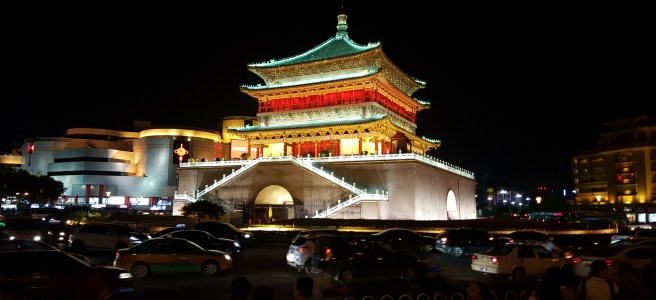
Well not really a first look, but my first for this trip and this blog.1 I left Xi’an mid-morning on Tuesday on a high-speed train to Beijing. The Xi’an high-speed train station (across town from the regular train station) is its own marvel. With more than 20 platforms, the whole complex felt a lot more like an airport—complete with security checks, x-ray machines, pat-downs, and gate-checks—than a train station, and it was easily as big as a standard international airport terminal, too.

beijing-1-20160906-ame-092621

Continue reading “Dispatches from Abroad: A First Look at, and Taste of, Beijing”

The unBalanced ecoLOGist: Help Science Meet Art at ESA 2017 (I)

I’m taking a day off from writing about my scientific and culinary adventures in China, and turning my attention to science and art. I spend a lot of time thinking about the relationship between science and art, but not in the way that it is mostly written and talked about, which is art drawing influence from science and technology, and reinterpreting it for different audiences. Rather, I’m particularly interested in how science and scientists – which in my case means ecology and ecologists – have been and continue to be influenced by art and the humanities in general. I’ve even written a couple of papers on the subject, which you can read elsewhere on this site.

But right now, I’m working with Carri LeRoy, a faculty member at the Evergreen State College in Washington State, to organize an “ignite” session for next summer’s Ecological Society of America meetings, to be held in Portland, Oregon. If you’re interested in this topic, and want to give a talk/presentation/exhibition or join the discussion, then…

Continue reading “The unBalanced ecoLOGist: Help Science Meet Art at ESA 2017 (I)”

Dispatches from Abroad: Two Feasts and a Biang-biang

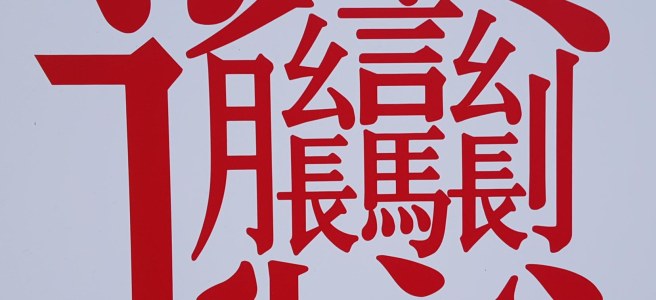
There is so much good food in Xi’an, it’s hard to resist yet another posting on its delicacies. Today’s foodie-fest reviews two celebratory dinners and a noodle interlude. The first feast occurred just over a week ago, when the students and post-docs in Professor Chen Yi-ping’s lab took me out for a fish grill the night before I left for the panda road trip (summarized in the previous three-part post on Walking in the Footsteps of the Giant Panda [I, II, III]). The second feast was Monday night, when the whole lab took me out for a farewell lamb barbecue at a local farm-to-table restaurant. In between, I finally encountered the mythical biang-biang noodle.

Continue reading “Dispatches from Abroad: Two Feasts and a Biang-biang”

Dispatches from Abroad: On Monumentality

A number of years ago, Alfred Runte wrote an insightful article on the rationale for the creation of the United States’ (US) National Park System (“The National Park idea: origins and paradox of the American experience,” published in the Journal of Forest History 21[2], 64-75; April 1977)   He argued that in the 19th century, the US was still insecure about its identity as a nation. We felt that we didn’t have the cultural history, cathedrals, and other iconic buildings that Europe did, but we had awesome landscapes that Europe couldn’t match. This fixation on monumentality was enshrined in the enabling legislation for the National Parks (the 1916 Organic Act), has carried forward in management strategies and policies that emphasize retaining the parks in their “original condition”, and persists in such language as “National Monuments”.

But why write about this now, from China?

Continue reading “Dispatches from Abroad: On Monumentality”

The unBalanced ecoLOGist Abroad: In the Footsteps of the Giant Panda (III)

After a final night in the city of Ya’an, Sichuan Province, we headed north back into Shaanxi Province, following the Bao Jiang (Bao River) towards Baoji. We were on a small, older road, but it is being replaced by the new Baohan Expressway. This superhighway will run 200 or so kilometers (at least 12o miles), and will have been built, start to finish, in about 3 years. According to Chen Dong, building a highway like this is considered an “easy” project: it follows an existing route (in this case, right up a riverbed; the existing road is built above the river on an old terrace), uses established precast concrete technology, and takes advantage of China’s immense and hungry labor force.

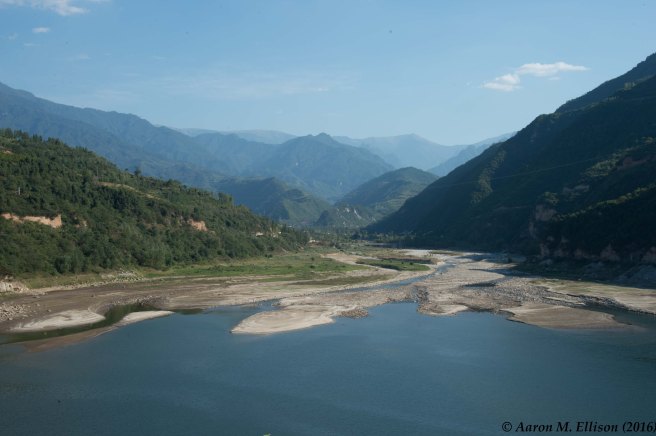
PandasWereHere-20160901-AME-7816But I think that it marks the end of the road for the Qinling panda. The sign at left, overlooking a reservoir (photo below; ironically established as a national wetland reserve – once the lake behind the dam silts in, it should be a very nice wetland!), reads: 熊猫故里 (xióng māo gù lĭ), literally the “hometown” of the panda, but idiomatically meaning “pandas once lived here [in this their native home], but they don’t anymore.”BaoJiangreservoirwetland-20160901-AME-7809
Continue reading “The unBalanced ecoLOGist Abroad: In the Footsteps of the Giant Panda (III)”

The unBalanced ecoLOGist Abroad: In the Footsteps of the Giant Panda (II)

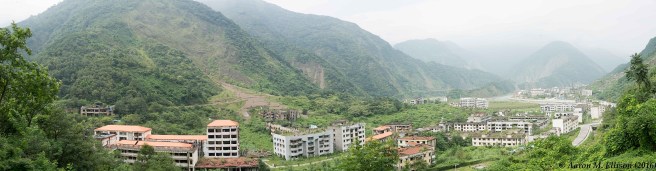
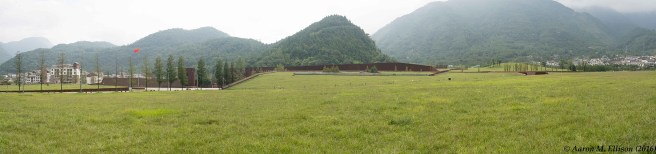
We had hoped to get to the Wolong Panda Reserve, but the roads, damaged by the 12.V.2008 Wenchuan earthquake (mganitude 8.0) and more recently by heavy rains and flooding, were not passable. We re-routed to Beichuan, which was the city closest to the epicenter of the earthquake, the ruins of which have been left standing as a memorial to the >87,000 people who died and > 15,000,000 who were displaced and relocated.

Beichan-20160831-AME-small
Beichuan ruins
BeichanMuseum-20160831-AME-small
Wenchuan earthquake museum grounds

We did pass through what had been panda reserve lands, but which now, more than eight years after the earthquake, have few, if any, pandas remaining. All the pandas that had been at the Wolong breeding center were relocated after the earthquake to Chengdu (see yesterday’s post, below).

Continue reading “The unBalanced ecoLOGist Abroad: In the Footsteps of the Giant Panda (II)”