The clock is running, and slots are filling, so if you’re interested in talking about how making art/music/creative writing has influenced your science, seeing art/listening to music/reading creative writing has changed your science, or how a collaboration with an artist has influenced your science, now’s the time to volunteer to present (and since it will be an ignite session, the talk doesn’t count towards the one-talk limit at the meeting!).
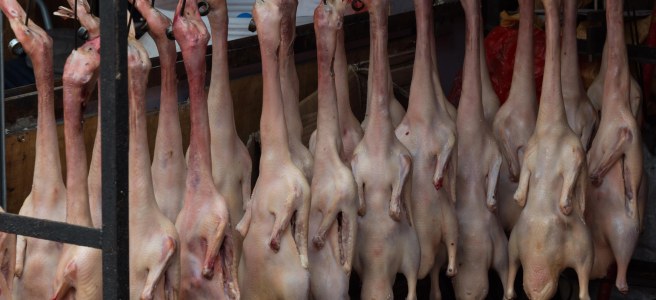
One of my Malaysian-Chinese colleagues once told me that “if it walks with its back to the sky” then it’s fair game for a Chinese table. The twice-daily walk through one of Kunming’s open-air markets between my hotel and the Kunming Institute of Zoology (KIZ) where I’m spending my last 10 days in China certainly supports her adage. It also should give one pause at the dinner table.
I got to Kunming two days ago, but you’ll still have to wait a bit to see photos of crispy-fried bamboo worms and grasshopper garnish. In the meantime, take a break from the three-ring circus that is the US elections, and enjoy these photographs from my last few weeks in Beijing. And don’t forget to check out my Best of the Best, with Beijing updates!
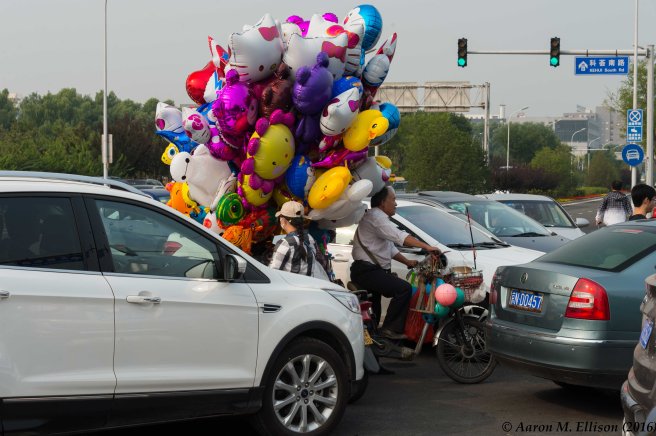
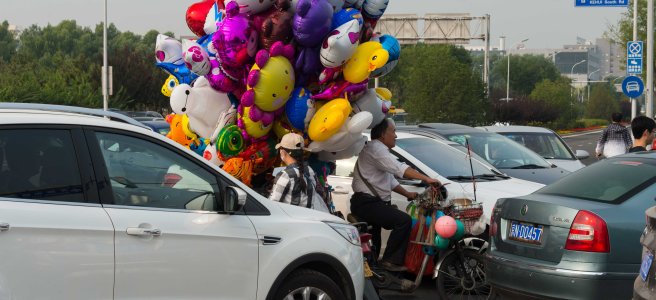
I’ve been in China for over seven weeks now, and as a people-watcher and photographer, nothing has caught my eye more than the panoply of three-wheeled vehicles meandering the roads. When I was a college student in the late 1970s studying Chinese, there were virtually no cars in China; just shy of 40 years later, BMWs outnumber bicycles in many Chinese cities, and the two-wheelers once pushed by peds on pedals are now mostly electrified. But through it all, the trikes remain, anachronistic work-horses that fill the gaps between bikes and BYDs, Vespas and Teslas.
I spent a few hours this afternoon—my last in Beijing before I move on to Kunming tomorrow morning—walking the streets and alleys, photographing three-wheelers, and reflecting on stasis and evolution in transportation systems.
Perhaps the most inescapable aspect of being in China is the feeling one gets from being in a sea of over 1.3 billion people in a country the size of the United States (which has less than 1/3 of that number). It always feels like every last one of them is in the street at the same time I’m trying to cross it. Yet for all the traffic in its innumerable forms—cars, tricycles, pedal-powered and electric bicycles, donkey-drawn carts, and feet—going every which way at the same time, there are few accidents. The vehicles and pedestrians move at slow speeds and just seem to flow organically around one another in a Brownian dance.
Brownian traffic flow at an intersection near Beijing’s Olympic Park
But even more noticeable to a Western (i.e., US, European) eye than the crowds is the cultural tendency in China for people to do things in groups, often really large ones. The most noticeable are the groups exercising together on the streets and in the parks, but tour groups, school groups (all in identical t-shirts), and large family groups are everywhere and personal space—so important in many Western cultures—feels painfully absent.
Evening exercise on the plaza at Beijing’s Olympic Park
And as a visitor here, albeit one who was invited to various institutions and is being supported by the Chinese government, this feeling is accentuated by the seemingly constant companionship (or in my more churlish moods, “handling”) of friends and colleagues who appear to manage effortlessly to fill virtually every waking hour of my days here with seminars, field trips, discussions, and meals—all activities that keep me en-grouped.
So while I’ve been in China, not only have I had to work hard find and make time for myself when I’m not otherwise sleeping, but I have also found myself looking for instances and examples of how people here carve out even small amounts of personal space. Continue reading “Dispatches from Abroad: Finding Space in a Crowd”→
The seminar storm has wound down – in the last 11 days, I’ve given 12 talks at 10 universities and research institutes in three major cities spanning nearly 2000 km It’s a new personal record for me that, despite the daily adrenaline rushes, I’d rather not repeat anytime soon.
Since the beginning of this week, I’ve been based at the Chinese Academy of Science’s Research Center for Eco-Environmental Research (RCEES) in northwest Beijing, conveniently down the road from the Chinese National Science Foundation offices and more-or-less around the corner from Peking University. The skies have been clear, the taxi rides uneventful as I’ve shuttled to and from seminars at the Institute for Tibetan Plateau Research [2], Beijing Normal University [1], Minzu University [1], Peking University [2], RCEES [2], the food plentiful and interesting, and the friends and colleagues wonderful. And today, October 1, is China’s National Day, celebrating the founding of the People’s Republic of China on this day in 1949.
On Sunday (that’s right, Sunday), Eryuan Liang and I took the morning high-speed train 1200 km in under 4 hours, and on time to the minute, from Beijing to Nanjing to give afternoon seminars at Nanjing Forestry University (established 1902). I was on tap to talk about forest foundation species, while Eryuan was set to talk about dresses (actually alpine treelines, but without any sense or irony, the “p” was lost in translation). Sundays are great days to give seminars; attendance is always good because the students don’t have classes and the faculty don’t have meetings. The seminars were fine, but the banquet afterwards …
It’s been almost a week since I’ve found any time to write a post from China. As I wrote last week, I left Beijing on Monday for Shenyang: the first four days of what has now turned into a 10-day, 9-lecture typhoon (yes indeed, a lot of hot air swirling around!) / movable feast (click on any image to view larger ones in a slide show).
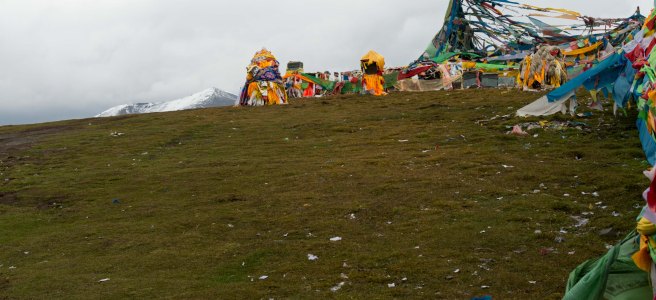
I’m leaving Xining today on a late flight back to Beijing, followed by a seven-day, six-lecture whirlwind through Shenyang (3.5 hours north of Beijing by high-speed rail), Beijing, and Nanjing (4 hours south of Beijing by high-speed rail) and then back to Beijing again for a full day of meetings and more lectures. So until the next blog posting from the eye of that storm, enjoy my favorite photos from across Tibetan Plateau and be sure to check out the “Best of the Best“.
It took me a while, but on the night of the Mid-Autumn Festival, it finally occurred to me, when we reached Dunhuang with its massive sand dunes and crescent-moon lake presided over by a reconstructed temple, that all of the cities we’d stopped at on our nine-day circuit from Xining to Wulan to Dulan to Ge’ermu to Dunhuang to Shangye and back to Xining tonight were oases in an otherwise parched desert. These ancient springs and watering-holes had been obvious points of layover for camel trains, traders, monks, and charlatans, and now are thriving cities living on depleted groundwater and glacial meltwater-fed rivers.
Crescent-moon lake at the Mingshashan dunes in Dunhuang. The lake, once amply supplied by groundwater, now needs to be pump-filled from alternative water supplies.



 Since the beginning of this week, I’ve been based at the Chinese Academy of Science’s Research Center for Eco-Environmental Research (RCEES) in northwest Beijing, conveniently down the road from the Chinese National Science Foundation offices and more-or-less around the corner from Peking University. The skies have been clear, the taxi rides uneventful as I’ve shuttled to and from seminars at the



 The Unbalanced Ecologist