The unBalanced ecoLOGogist: Up The River and into The Woods

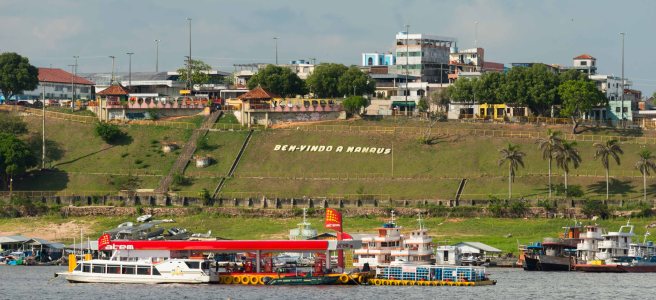
Having spent the better part of two weeks moving down the Amazon River from Tabatinga to Belém, I’m now in the midst of the last 2-1/2 weeks of my year-long sabbatical leave, working on all things ants with my friend and colleague Rogério Silva at the Museu Paraense Emilio Goeldi. Rogério and I have been working on ecological similarities and differences between temperate and tropical ants. He’s visited me twice at Harvard Forest and now, with support from the Museum in Belém, I have an opportunity to learn first-hand about the ants of the Brazilian rainforest.

But first we have to get there.

Continue reading “The unBalanced ecoLOGogist: Up The River and into The Woods”

Dispatches from Abroad: Reflections on the 2016 Election (II)—The Politics of Identity and the Destructiveness of Identity Politics

This is the second part of my reflections on the 2016 US presidential election. As with Part I (“An Elegy for my Home”), I emphasize that these are personal reflections and opinions; the writing is incomplete and unpolished. I welcome constructive engagement, discussion, and dialogue about them; please post comments here, on Twitter, or send me email.

Continue reading “Dispatches from Abroad: Reflections on the 2016 Election (II)—The Politics of Identity and the Destructiveness of Identity Politics”

Dispatches from Abroad: Down the Amazon (III) – Manaus to Belém

Ashore in Belém after five days and four nights on the Amazon and its tributaries on board the Amazon Star, here’s the travel-blog of what I though would be my final trip on the Amazon. But in truth, I’ll head back upriver on Wednesday for 11 days of field work… more on that coming up!

23 November 2016

Up at dawn, lock the duffel, stow the laptop, scarf down fruit, granola, chocolate cake, and tea at the Go-Inn Manaus buffet, and head for the river.

Continue reading “Dispatches from Abroad: Down the Amazon (III) – Manaus to Belém”

The unBalanced ecoLOGist: On Tipping Points, Regime Shifts, and the Balance of Nature

While washed up in Manaus, I’ve taken a few hours to catch up on some recent papers in the (technical) ecological literature. A new paper by Egbert van Nes et al. in the most recent issue of Trends in Ecology and Evolution caught my attention. Entitled “What do you mean, ‘tipping point’?“, van Nes et al. encapsulate well the competing ideas and definitions of tipping points in the ecological and broader literature, but then end up arguing for a broad definition: “any situation where accelerating change caused by positive feedback drives the system to a new state.” But they then go on to say that their “proposed definition essentially boils down to the necessary conditions for [Malcom] Gladwell’s examples where a small initial change makes a big difference.”

I think this is unfortunate. They give too much credence to Gladwell’s sloppy handling of tipping points in his book, their  broad definition will lead to a proliferation of “tipping points,” and such vagueness can only result in so much watering down of the term as to render it meaningless.

So with that in mind, I offer up for today’s posting an essay I wrote three years ago but never published. I post it here, unedited from 11 September 2013 (albeit with a few [editorial clarifications]). Perhaps an updated version could find a broader audience somewhere; suggestions welcome!


On tipping points, regime shifts, and the balance of nature

“Five-nine” doesn’t have quite the cadence as “nine-eleven,” but when we look back on the early 21st century, May 9, 2013—the day that the concentration of carbon dioxide (CO2) in the atmosphere exceeded 400 parts per million (ppm) for the first time in recorded history—may be seen as a far more important date than September 11, 2001. If the scenario described in the Scientific Consensus on Maintaining Humanity’s Life Support Systems in the 21st Century by Anthony Barnowsky and his colleagues at Berkeley[1], along with more than 500 other scientists, including Nobel laureates, members of the National Academies of Sciences, and other luminaries is true, Five-nine will be seen as the long-anticipated tipping point whereby human impacts have caused irrevocable harm to our planet. Or perhaps not. Perhaps there is still time to take the concrete, immediate actions Barnowsky et al. suggest—suggestions echoed by President Barack Obama in his June 25 [2013] speech at Georgetown University—that would ensure a sustainable, high-quality future. Or maybe we’ll just keep muddling along, slowly and steadily acclimating to our new lives on a now unfamiliar world, which, to distinguish it from our familiar “Earth,” Bill McKibben christened “Planet Eaarth”: durably, sturdily, stably, hardily, and robustly.

Continue reading “The unBalanced ecoLOGist: On Tipping Points, Regime Shifts, and the Balance of Nature”

Dispatches from Abroad: Down the Amazon (II) – Washed up in Manaus

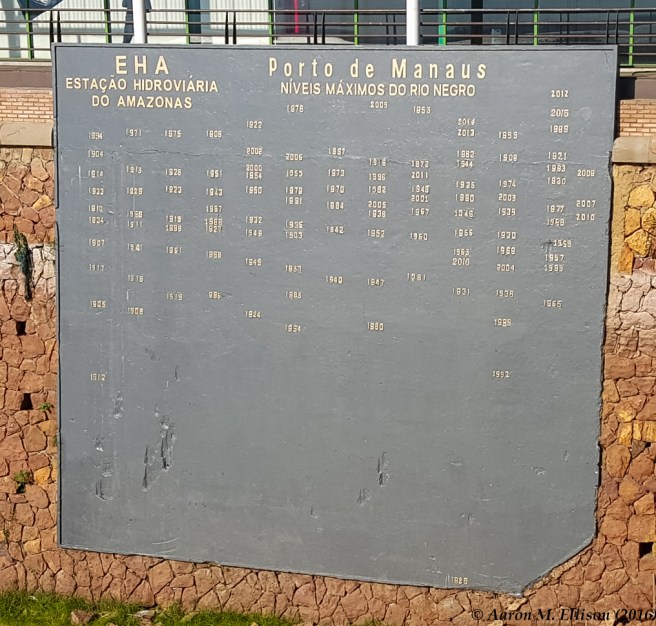
My riverine interlude between Leticia and Belém has been punctuated by a stopover in Manaus, a bustling industrial and most unlikely city of more than 2 million people located at the junction of the Rio Negro and the Rio Solimões. Following the 4-day, 3-night boat trip from Tabatinga described in the first part of this travel-blog, I arrived at Manaus late Saturday. A long walk up the floating ramp brought me in sight of the famous plaque of river heights, a wonderful example of “physical” data visualization (for more, check out this web-site: http://dataphys.org/list/ which I recently discovered thanks to my friend and colleague David Buckley Borden).

manaus-levels-20161119-ame-154724
Maximum heights of the Rio Negro at the Port of Manaus

As I well knew, 2015 was one of the highest levels on record, surpassed only by 2012 and just barely by 2009. The four years 2012-2015 were in the top 10 since records began more than a century ago, whereas 2016 was in the lower-middle of the pack. A great classroom exercise would be to digitize and plot these data relative to other indicators of climatic change.

I had hoped that I’d spend a couple of nights in Manaus and then catch a boat on Monday further downriver to Belém. I learned Sunday morning, though, that direct boats to Belém leave only Wednesdays and Saturdays. So rather than take a boat Monday to Santarem and then chill there for another boat onward to Belém, I opted to book the Wednesday boat and spend a couple of extra days exploring Manaus.

Continue reading “Dispatches from Abroad: Down the Amazon (II) – Washed up in Manaus”

Dispatches from Abroad: Down the Amazon (I) – Leticia & Tabatinga to Manaus

16 November 2016

After five days in Colombia—two in Leticia bracketing three at Parque Nacional Amacayacu, I crossed the transparent border between Colombia and Brazil, from Leticia into Tabatinga, where I boarded the ferry boat F/B Diamante for a four-day trip down the Amazon to Manaus (click on the thumbnails to enlarge the photos).

Continue reading “Dispatches from Abroad: Down the Amazon (I) – Leticia & Tabatinga to Manaus”

Dispatches from Abroad: Reflections on the 2016 Election (I)—An Elegy for my Home

I’ve been traveling and working outside of the US since the beginning of August, and watched the evolution, media/twitter/blog coverage, and eventual vote count of the US presidential election unfold from abroad—passing through degrees of disbelief, astonishment, and horror—but also seeing it with the perspectives of physical distance and those gained through the eyes of citizens of other countries. During the two weeks leading up to the election, I was simultaneously engrossed in developing new mathematical statistics and depressed by what I could clearly see, from an overseas vantage point, was going to go down on November 8. And although I voted in Massachusetts (the first person on the first day of early voting in my small rural town—which, contra the Commonwealth overall, went for Trump by a small margin ) while I was in transit between Tokyo and Valparaiso, I suffered no illusion that my vote for Hillary would make a difference, either statewide (Massachusetts is, of course, the bluest of the blue states, notable for being the only state to vote for McGovern against Nixon in 1972) or nationally (the writing was on the wall for anyone who could read it).

As I expect many travelers and ex-pats also did, I stayed up all of election night watching the returns, until the election was called for Trump at close to 2am Valparaiso time. The next day, I watched the sunrise over the docks of Valparaiso harbor, did my daily 45-minute walk up (northeast) the esplanade, past the omnipresent graffiti, murals, stray dogs, seagulls, sea lions, and pelicans, paused to dip my feet in the icy-cold Pacific Ocean, climbed up the daily 108 stairs to the mathematics quad, and then walked up the last three flights of stairs to my temporary office at the Universidad Técnica Federico Santa María (USM), where I skyped my fiancée and had a good cry – for my country, for my family and loved ones, for myself, and for the future.

I spent a lot of that day talking about the election with Flossie and with my three friends—Ronny Vallejos, a statistician at USM, and Hannah Buckley and Brad Case, ecologists from Lincoln University in New Zealand—with whom I was working at USM for the two weeks I was there. And I thought it would be worth setting down here the common themes and ideas that emerged in those conversations, filtered through another few days of reading, thinking, walking, and flying.

These reflections come in two parts. This one, entitled “An Elegy for my Home”, and the next one, entitled “The Politics of Identity and the Destructiveness of Identity Politics”. I emphasize that these are personal reflections and opinions set down as stream-of-consciousness with little editing. The writing is rough and the ideas incomplete. But I needed to start somewhere, as the run-up to the election, the election itself, and the few days aftermath have made it hard to focus coherently. I welcome constructive engagement, discussion, and dialogue about them; please post comments here, on Twitter, or send me email.

Continue reading “Dispatches from Abroad: Reflections on the 2016 Election (I)—An Elegy for my Home”

Dispatches from Abroad: China, Farewell

After nine weeks and nine provinces, I left China on October 15. I spent the following week in Japan – a short vacation in Tokyo and at a ryokan in Hakone – before returning to the US on October 21. Just in time to vote early in my home state of Massachusetts (I was the first in my small town to vote on the first day of early voting in Massachusetts, October 24), before heading on to South America for the last two months of my sabbatical.

So now, settled in at the Hotel Ibis on the waterfront of picturesque Valparaiso, Chile, and gearing up for two weeks of statistics research with my colleagues Ronny Vallejos at the Universidad Tecnica Federico Santa Maria here in Valparaiso, and Hannah Buckley and Brad Case from Lincoln University in New Zealand, I thought I’d set down a few semi-final reflections about China. If you’re not into reading, though, you can skip over the text and go right on to my favorite photos from my time in China.

Continue reading “Dispatches from Abroad: China, Farewell”

The unBalanced ecoLOGist: On Getting Real about Conservation

It’s been just over a week since I published my World View, “It’s time to get real about conservation” in Nature. The response to this op-ed has been, at least to me, nothing short of astonishing and a bit overwhelming. Individuals have actually commented on it on Nature’s web page, it’s ricocheted around the Twitterverse, and I’ve gotten a handful of new followers and dozens of direct messages and emails thanking me for the catharsis (really!) of writing what others have thought about but haven’t been willing to say aloud, looking for advice on moving into conservation careers, and probing for ways to support conservation activism and activists. A few asked for additional background data, examples of biodiversity triage, and more suggestions for what to do next. So I thought I’d use some plane time between Kunming (China) and Tokyo (Japan) to provide a bit of background on the op-ed, give credit where credit is more than due, and to expand on some of the key points.

Continue reading “The unBalanced ecoLOGist: On Getting Real about Conservation”