instability: Photographs of the Unexpected

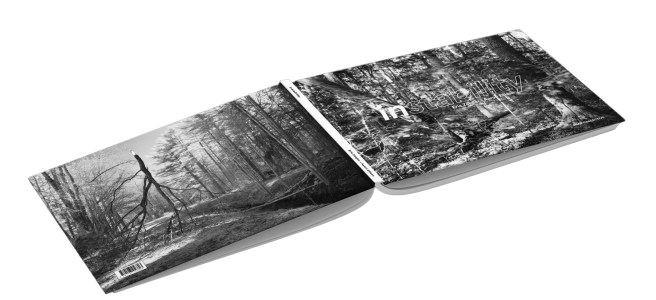
I’m pleased to announce the forthcoming publication of instability: Photographs of the Unexpected, a book of photographs created in collaboration with Eric Zeigler.


You can now pre-order instability, and the first 25 orders from the USA will also receive a signed photographic print from the book.
Pre-orders received by September 29 will be shipped to arrive by the winter holidays!


instability

Watch for long enough, and anything that appears to be stable will reveal its true perpetual state of instability. But imaging devices record single glances of the world: Crack! Trees fall, shutters snap, photographs are fixed. We have been conditioned to expect a photograph to capture decisive moments, but how do we know which ones are decisive? Further, when we overlay the fixed objectif-icity of still images on film, paper, and glowing screens onto our expectations of how the world “works,” we are subconsciously disregarding change and misinterpreting the instability of the reality we live in.

We visualize this instability in 145 images that we created from 2020 through 2024 using contemporary versions of 19th-century dry collodion glass plates, 20th-century film, and new digital technologies. We use these different methods to challenge interpretations of the assumed objective reality of a photograph and illuminate contradictions in 21st-century narratives of environmental stability and preservation. Following the suggestion of Walter Benjamin (in his Illuminations), we work to “attain a conception of history [and the present] that is in keeping with the tradition of the oppressed, which teaches us that thestate of emergencyin which we live is not the exception but the rule.” With our images, we reclaim the aesthetics behind the myths of the Westward Expansion, the American Frontier, and similar colonialist activities that have occurred throughout the world, and we record modern ecosystems deemed healthy and stable only because we’ve left them alone. For example, the economic progress flowing down rivers and onto the transcontinental railroads ironically created the context for preservation of old-growth forests—tiny islands of nature within a vast ocean of unchecked development. Are these reserves or theme parks? Are they really stable, unchanging, and, as the US National Park Service would have it, “unimpaired?” How are they connected to the human-modified environments around them? The essence of their ongoing and essential decay, normally hidden behind an opaque, yet gossamer fog, is unveiled in instability.


The first incarnation of instability was produced as an oversize (19 x 13-inch) “book dummy” entitled DoubleTake, which was entered into photobook competitions around the world. DoubleTake was chosen for inclusion in the 14th Annual Photobook Exhibition at the Griffin Museum of Photography in Winchester, Massachusetts, and it is now in their permanent collection. It also accompanied our solo exhibition of selected photographs in July 2024 at the Czong Institute for Contemporary Art in Gimpo, Republic of Korea, and has been accessed into their permanent collection, too. A smaller (9 x 6-inch), limited-edition version of DoubleTake accompanied our solo exhibition in August 2024 at Hartwick Pines State Park in Grayling, Michigan.

Finally, DoubleTake – now greatly expanded (from 51 to 145 images) and renamed instability – was chosen by the Danish publisher Snap Collective to be one of the photobooks they are publishing in 2024.


Learn more about, and see selected images from, instability here
Pre-order instability before September 29 to ensure delivery by the winter holidays.
The first 25 orders from the USA will also receive a signed photographic print from the book.
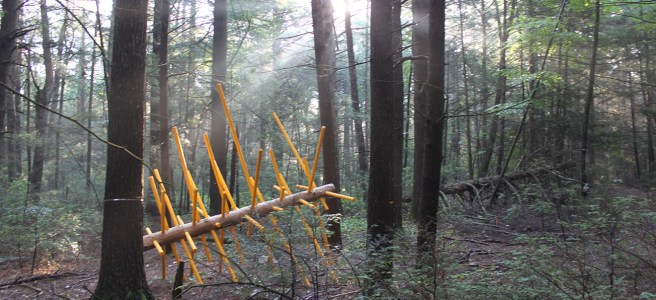
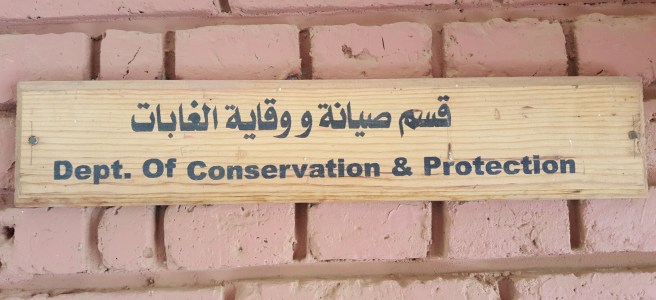
The unBalanced ecoLOGist: Hemlock Hospice [II]

Hemlock Hospice opens to the public on October 7, 2017 at noon, and will be up for more than a year (through November 18, 2018). We have a website, a schedule of events for the opening reception, and are putting the finishing touches on the last of more than a dozen sculptural pieces emplaced thoughtfully throughout a new interpretive trail within the Prospect Hill Tract at the Harvard Forest. A substantial outreach effort is leading to press coverage, interviews, seminar invitations, etc., especially in the art world. Scientists, though, generally are a bit more muted in their response or apparent interest. Why might that be?

In pursuit of an answer, I explore here the importance of empathy in field research.

empathy, n. “The ability to understand and appreciate another person’s feelings, experience, etc.”

Oxford English Dictionary (OED) online, June 2017. Accessed 10 September 2017

Continue reading “The unBalanced ecoLOGist: Hemlock Hospice [II]”

The unBalanced ecoLOGist. Guest blog: An LTER for Sudan?

This week The unBalanced ecoLOGist features its first guest blog.[1] Written by Ahmed Siddig[2]  and edited only lightly for posting, it re-caps themes of the short-course on the science of biodiversity that Ahmed and I taught in Khartoum, Sudan, earlier this month and sketches a proposal for establishing a long-term ecological research (LTER) program in Sudan.[3]

Continue reading “The unBalanced ecoLOGist. Guest blog: An LTER for Sudan?”

Dispatches from Abroad: China, Farewell

After nine weeks and nine provinces, I left China on October 15. I spent the following week in Japan – a short vacation in Tokyo and at a ryokan in Hakone – before returning to the US on October 21. Just in time to vote early in my home state of Massachusetts (I was the first in my small town to vote on the first day of early voting in Massachusetts, October 24), before heading on to South America for the last two months of my sabbatical.

So now, settled in at the Hotel Ibis on the waterfront of picturesque Valparaiso, Chile, and gearing up for two weeks of statistics research with my colleagues Ronny Vallejos at the Universidad Tecnica Federico Santa Maria here in Valparaiso, and Hannah Buckley and Brad Case from Lincoln University in New Zealand, I thought I’d set down a few semi-final reflections about China. If you’re not into reading, though, you can skip over the text and go right on to my favorite photos from my time in China.

Continue reading “Dispatches from Abroad: China, Farewell”

Dispatches from Abroad: Truckin’ with Trikes

I’ve been in China for over seven weeks now, and as a people-watcher and photographer, nothing has caught my eye more than the panoply of three-wheeled vehicles meandering the roads. When I was a college student in the late 1970s studying Chinese, there were virtually no cars in China; just shy of 40 years later, BMWs outnumber bicycles in many Chinese cities, and the two-wheelers once pushed by peds on pedals are now mostly electrified. But through it all, the trikes remain, anachronistic work-horses that fill the gaps between bikes and BYDs, Vespas and Teslas.

I spent a few hours this afternoon—my last in Beijing before I move on to Kunming tomorrow morning—walking the streets and alleys, photographing three-wheelers, and reflecting on stasis and evolution in transportation systems.

Continue reading “Dispatches from Abroad: Truckin’ with Trikes”

Dispatches from Abroad: Finding Space in a Crowd

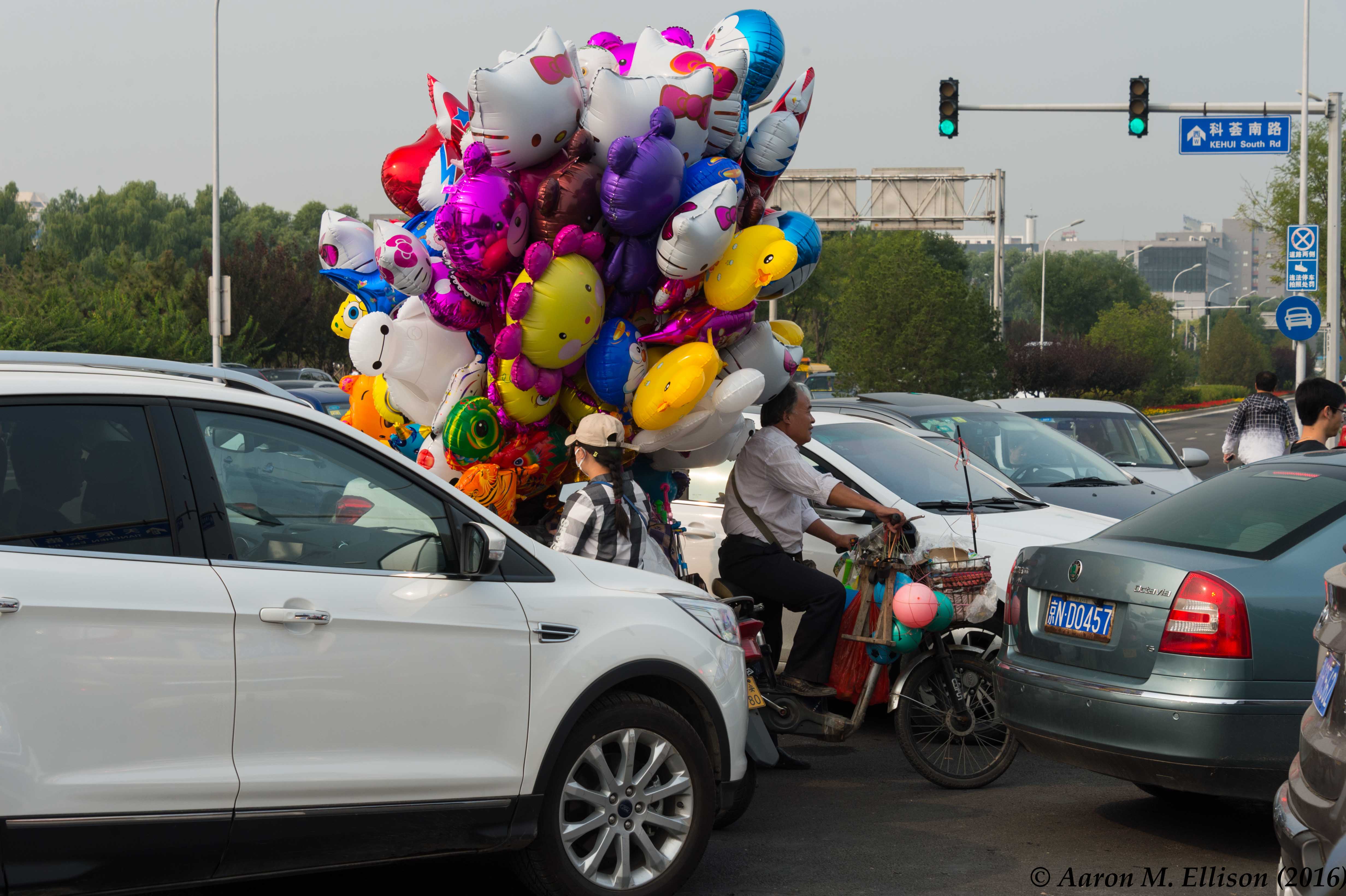
Perhaps the most inescapable aspect of being in China is the feeling one gets from being in a sea of over 1.3 billion people in a country the size of the United States (which has less than 1/3 of that number). It always feels like every last one of them is in the street at the same time I’m trying to cross it. Yet for all the traffic in its innumerable forms—cars, tricycles, pedal-powered and electric bicycles, donkey-drawn carts, and feet—going every which way at the same time, there are few accidents. The vehicles and pedestrians move at slow speeds and just seem to flow organically around one another in a Brownian dance.

beijing-20160924-ame-8673
Brownian traffic flow at an intersection near Beijing’s Olympic Park

But even more noticeable to a Western (i.e., US, European) eye than the crowds is the cultural tendency in China for people to do things in groups, often really large ones. The most noticeable are the groups exercising together on the streets and in the parks, but tour groups, school groups (all in identical t-shirts), and large family groups are everywhere and personal space—so important in many Western cultures—feels painfully absent.

beijing-exercise-20160908-ame-200208
Evening exercise on the plaza at Beijing’s Olympic Park

And as a visitor here, albeit one who was invited to various institutions and is being supported by the Chinese government, this feeling is accentuated by the seemingly constant companionship (or in my more churlish moods, “handling”) of friends and colleagues who appear to manage effortlessly to fill virtually every waking hour of my days here with seminars, field trips, discussions, and meals—all activities that keep me en-grouped.

So while I’ve been in China, not only have I had to work hard find and make time for myself when I’m not otherwise sleeping, but I have also found myself looking for instances and examples of how people here carve out even small amounts of personal space. Continue reading “Dispatches from Abroad: Finding Space in a Crowd”

The unBalanced ecoLOGist: Help Science Meet Art at ESA 2017 (I)

I’m taking a day off from writing about my scientific and culinary adventures in China, and turning my attention to science and art. I spend a lot of time thinking about the relationship between science and art, but not in the way that it is mostly written and talked about, which is art drawing influence from science and technology, and reinterpreting it for different audiences. Rather, I’m particularly interested in how science and scientists – which in my case means ecology and ecologists – have been and continue to be influenced by art and the humanities in general. I’ve even written a couple of papers on the subject, which you can read elsewhere on this site.

But right now, I’m working with Carri LeRoy, a faculty member at the Evergreen State College in Washington State, to organize an “ignite” session for next summer’s Ecological Society of America meetings, to be held in Portland, Oregon. If you’re interested in this topic, and want to give a talk/presentation/exhibition or join the discussion, then…

Continue reading “The unBalanced ecoLOGist: Help Science Meet Art at ESA 2017 (I)”

Dispatches from Abroad: On Monumentality

A number of years ago, Alfred Runte wrote an insightful article on the rationale for the creation of the United States’ (US) National Park System (“The National Park idea: origins and paradox of the American experience,” published in the Journal of Forest History 21[2], 64-75; April 1977)   He argued that in the 19th century, the US was still insecure about its identity as a nation. We felt that we didn’t have the cultural history, cathedrals, and other iconic buildings that Europe did, but we had awesome landscapes that Europe couldn’t match. This fixation on monumentality was enshrined in the enabling legislation for the National Parks (the 1916 Organic Act), has carried forward in management strategies and policies that emphasize retaining the parks in their “original condition”, and persists in such language as “National Monuments”.

But why write about this now, from China?

Continue reading “Dispatches from Abroad: On Monumentality”

The unBalanced ecoLOGist Abroad: In the Footsteps of the Giant Panda (III)

After a final night in the city of Ya’an, Sichuan Province, we headed north back into Shaanxi Province, following the Bao Jiang (Bao River) towards Baoji. We were on a small, older road, but it is being replaced by the new Baohan Expressway. This superhighway will run 200 or so kilometers (at least 12o miles), and will have been built, start to finish, in about 3 years. According to Chen Dong, building a highway like this is considered an “easy” project: it follows an existing route (in this case, right up a riverbed; the existing road is built above the river on an old terrace), uses established precast concrete technology, and takes advantage of China’s immense and hungry labor force.

PandasWereHere-20160901-AME-7816But I think that it marks the end of the road for the Qinling panda. The sign at left, overlooking a reservoir (photo below; ironically established as a national wetland reserve – once the lake behind the dam silts in, it should be a very nice wetland!), reads: 熊猫故里 (xióng māo gù lĭ), literally the “hometown” of the panda, but idiomatically meaning “pandas once lived here [in this their native home], but they don’t anymore.”BaoJiangreservoirwetland-20160901-AME-7809

Continue reading “The unBalanced ecoLOGist Abroad: In the Footsteps of the Giant Panda (III)”

The unBalanced ecoLOGist Abroad: In the Footsteps of the Giant Panda (I)

After two weeks in downtown Xi’an, I, along with Professor Chen Yi-ping, graduate student Chen Dong, and an indefatigable driver Liu, set out on the morning of 29 August for a 6-day road trip through the Qinling Mountains of southern Shaanxi Province, northern Sichuan Province, and Gensu Province. The goal of this excursion is to introduce me to the two subspecies of panda (the Qinling and the Sichuan), their remaining habitat, and the challenges associated with conserving this iconic endangered species.

And of course, I am hoping to actually see a giant panda!

Continue reading “The unBalanced ecoLOGist Abroad: In the Footsteps of the Giant Panda (I)”