
My last annual round of crème brûlées ended in June 2022, just as the new post-pandemic normal was starting to take hold. July 2022 was remarkable not only for my lack of crème brûlées but also because I managed to spend the whole month at home in Boston. But I was on the road again in August, this time driving to Montreal (in an EV, of course) with Nick Gotelli for the Annual Meeting of the Ecological Society of America. I was attending the ESA meeting on behalf of the British Ecological Society’s journal, Methods in Ecology and Evolution, which, as its newly-appointed Executive Editor, I was helping steer towards gold open access—a goal that was reached in January 2023. I also got to reprise my role as roadie and maestro of the sound board for Nick & Company’s annual performance at the ESA meetings.
September was another month at home, gearing up and packing for what has turned out to be a full year of travel—away from home at least part of every month since last October, and which looks to continue unabated through mid-February of 2024.

On my last full day in Montreal, I had lunch and caught up on our 20-year research project on Eastern hemlock decline with Audrey Barker Plotkin at Les Pyrénées. The dessert menu featured a Crème Brûlée à la Catalane. Unlike the French crème brûlée, the Catalan version has only (or mostly) milk (no cream) in the custard, and traditionally is flavored with cinnamon and lemon peel rather than vanilla. The version at Les Pyrénées, however, was not obviously flavored either way, but was top-dressed with powdered sugar and a late-season (certainly not Canadian) strawberry. The crème custard was good, but really would have benefitted from heavy cream (although the thinner custard of the crème catalana is deliberate). The brûlée was well-done and burnt to a tee. Overall, it was well above average, but I still prefer the French recipe.
At the beginning of October, Flossie and I spent a few New York City for a few days—Flossie working with her colleagues and me taking in some museum shows and spending a tranquil afternoon at the Noguchi Museum in Queens. Just across the street from our midtown hotel was La Grande Boucherie, where we enjoyed a fine meal. As would be expected in a French restaurant, crème brûlée was on the dessert menu. Surprisingly, though, it came in two forms.
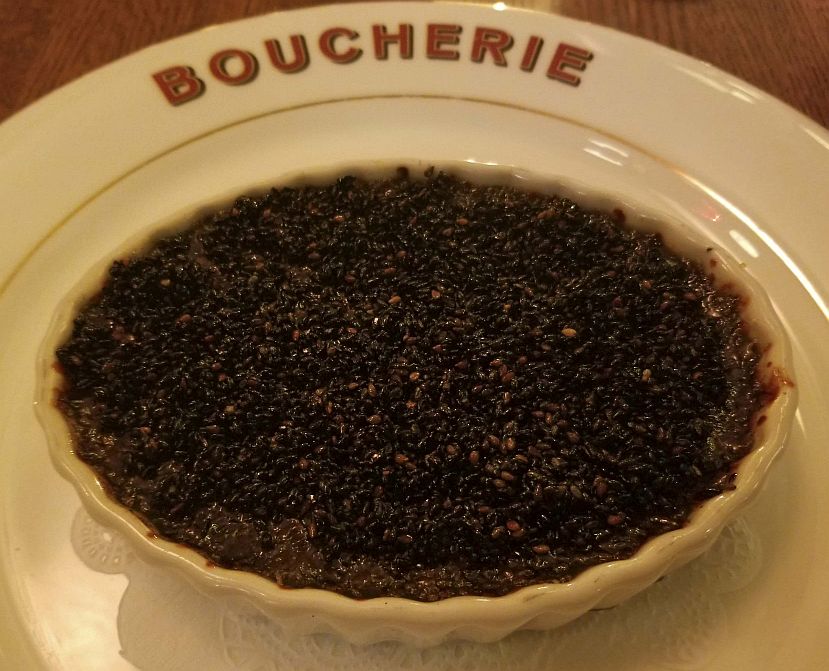

First up was the black sesame crème brûlée. This was like a sesame halva crossed with a crème custard with a semblance of a brûlée on top. The sesame added to the custard made for a crème that was less sweet than usual—and pleasantly so—but the coarser texture seemed not quite right for a crème brûlée. The brûlée itself was surprisingly good for what the menu referred to as caramelized Cantonese black sesame. Wafer-thin and just the right amount of crisp.
I returned the next afternoon for their regular crème brûlée. This one was superlative in all respects—the crème was as smooth as a custard should be with just the right sweetness and traces of Malagasy vanilla bean. The brûlée was as perfect as it could be. My evaluation was certainly not colored by the Boucherie’s signature Sazerac cocktail, made with Pernod and Pierre Ferrand 1840 cognac, that I sipped while waiting for the crème brûlée and espresso to arrive. This classic crème brûlée rated a rare 10, whereas the black sesame version deserves its own moniker.

A couple of weeks later, we had brunch at the Bistro du Midi in Boston. Their crème brûlée had a fine custard and a just-right brûlée, but as is often the case the added fruits were an unnecessary distraction even if they add a key food group to dessert. But really, why bother? We’re here for the sugar! (9/10)
The end of the year found me back in Chile on a pandemic-delayed visit to the Universidad Técnica Federico Santa María on a Fulbright Fellowship to work with my friend and colleague Ronny Vallejos on spatial statistics research. On this trip, my third since 2016, I stayed in nearby Viña del Mar, where I could enjoying late afternoon walks on the beach. Towards the end of my month in Chile, I had dinner at the Tierra del Fuego restaurant in Viña. The restaurant is justly famous for its fabulous seafood and its excellent beach-side setting with a beautiful view of the ocean. Their crème brûlée, though, was not nearly as good as their fish. The brûlée was a bit underdone but still crisp. The crème, however, was much more like a thin vanilla pudding than an actual crème custard, and was in desparate need of vanilla. This rated a generous 6, but at least the fruit was on the side.
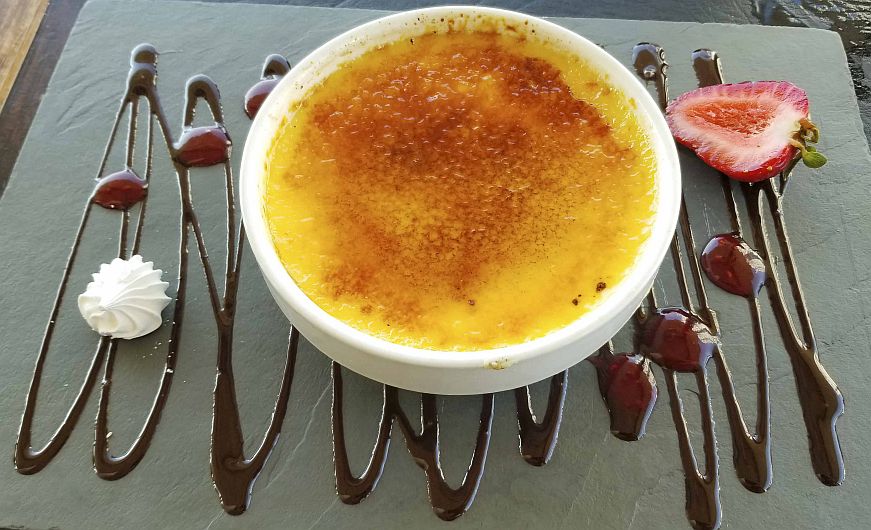
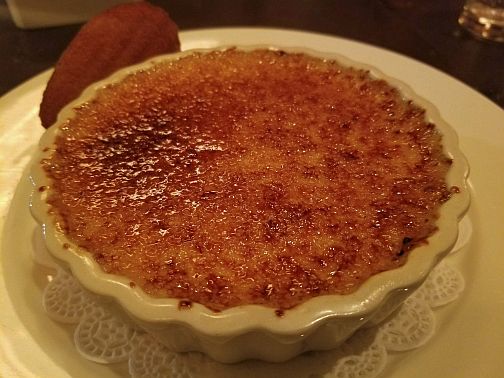
The new year found us back in the US, albeit only briefly. We made a quick trip to visit my parents in Philadelphia, and we had a fine family dinner at Parc on Rittenhouse Square. The crème brûlée here was a bit odd, though. The brûlée itself was well done and crisp and the crème seemed fine (albeit lacking in vanilla), but it left an odd aftertaste, or perhaps a thin film, on the tongue. Perhaps a bit too much heavy cream in the crème? Maybe they should talk to the Catalans – after all, both Les Pyrénées and Parc serve their crème brûlée with a soft cake-like biscuit on the side. (7/10)
After crème brûlée-less trips in to Edinburgh (December), Singapore (January), Toledo (Ohio), and Bamberg (Germany) (both in March), I returned to Germany for the entire the month of May to begin work on a new statistics textbook I’m writing with Carsten Dormann at the University of Freiburg.
May in Germany is the height of Spargelzeit (asparagus season), and the variety of asparagus preparations available at any pub or restaurant in Germany from roughly mid-April until St. John the Baptist Day (June 24) is simply mind-boggling. But I’ll stick to crème brûlée and save asparagus for another day.
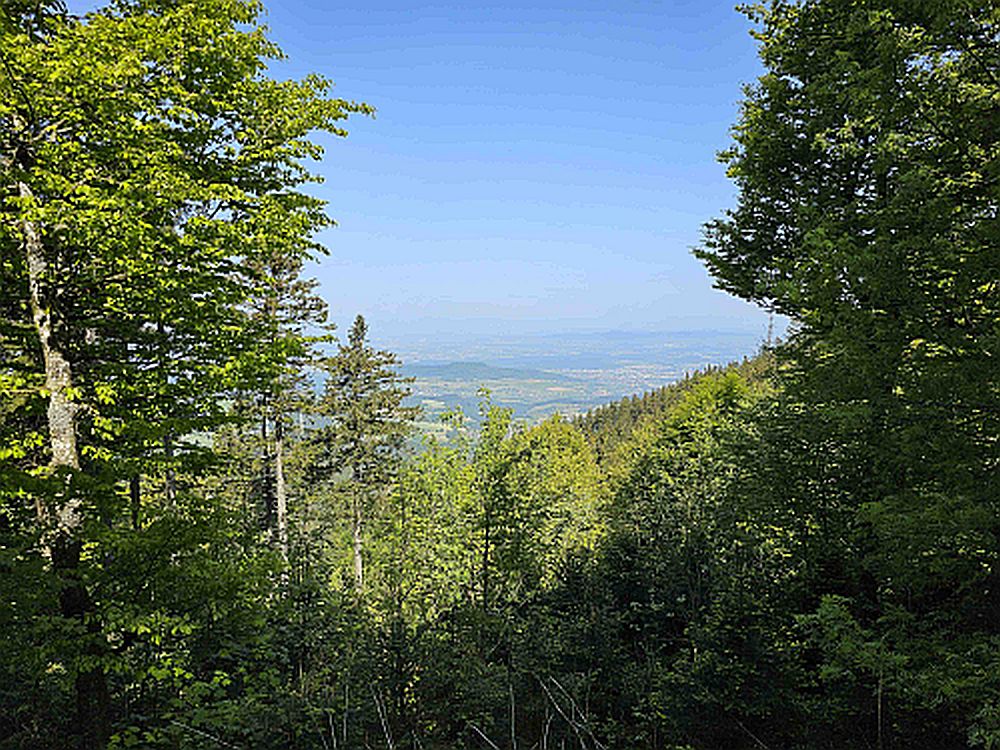
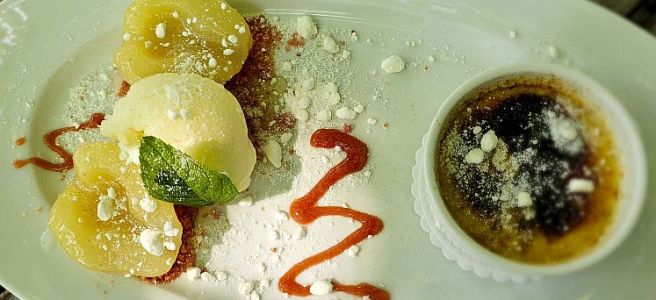
Just a few blocks from my apartment in Günterstal is the Kybfelsen Inn. During my month in Freiburg, I ate there twice and sampled two fine asparagus dinners. On my second visit, after a beautiful hike down the Schauinsland (after taking the cable car to the top), I finished my meal at the Inn with their cinnamon crème brûlée. The brûlée was excellent in all respects and the powdered sugar on top was a nice addition, for a change. Surprisingly to me, the cinnamon in the crème also was a real plus (shades of crème catalana). The crème itself, however was a bit too thick and tough, more like a thickened pudding than a crème custard.

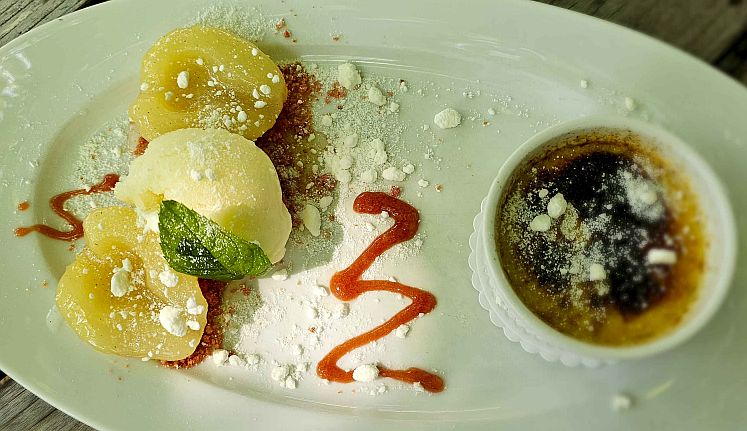
Like many crème brûlées around the world, this one also was accompanied by fruit, although thankfully not on top. The poached pairs on the side were excellent in their own right, and the pear sorbet provided a fine finish. An affogato completed the afternoon repast, after which I enjoyed the sugar high as long as it lasted. The crème brûlée rated only about a 7/10, but the overall dessert gets a 9.

Back stateside in June, I spent a week at the Ives Lake Field Station on Michigan’s Upper Peninusla as an artist-in-residence, and then the following week as one of two “Eminent Ecologists” at the Kellogg Biological Station towards the bottom-left of the Michigan mitten. At the South Kitchen restaurant a few miles from KBS, the crème brûlée came with two blackberries and a sprig of mint. The brûlée had the right amount of sugar but was underdone and a bit soft. The crème was grainy and oversweet. But after a week being exsanguinated by mosquitoes at Ives Lake, it was nice to have dessert—even one rated only a 6—without having to take breaks between spoonfulls, channelling Sisyphus while wielding The Executioner.
August brought the “trip of a lifetime” — a 3-week safari with my friend-since-childhood, Rich Gorelick. We spent more than two weeks criss-crossing Namibia, then spent five days in Botswana’s Chobe National Park and the Okavango Delta before finishing up on the Zimbabwean side of Victoria Falls. Quite unexpectedly, I had two crème brûlée’s on a single August day in Namibia.
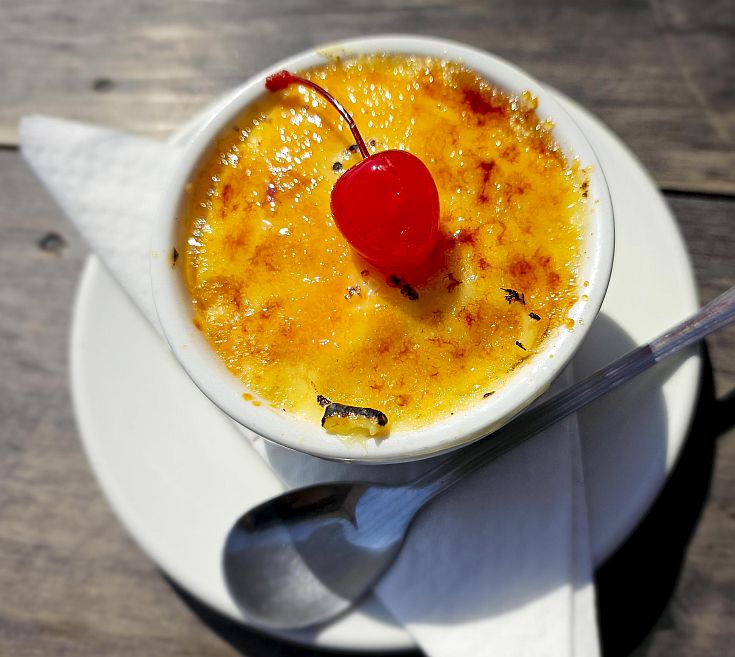
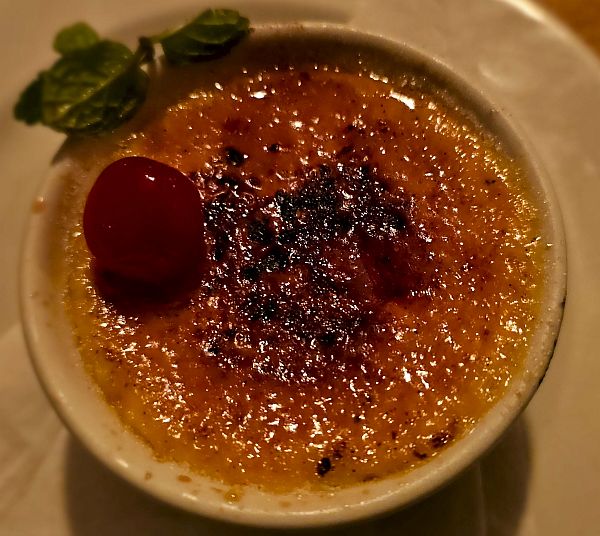
The first was at our morning coffee break at the Anchors Restaurant in Walvis Bay, just south of Swakopmund. Weirdly, they served the crème brûlée warm with a maraschino cherry on top. The brûlée was crunchy and fresh, if a bit on the sweet side. The crème was a very nice custard with a hint of lemon. Although the warmth was unexpected, it was welcome in the morning breeze and went very well with an espresso. At least an 8/10, maybe an 8.5, given the magnificent location.
The second was at dinner that same day, at The Tug Restaurant, which is perched at the end of a long and somewhat rickety jetty on Swakopmund’s waterfront. The restaurant itself is inside the restored Danie Hugo Tugboat, an oil-fired tug built in 1959 in Glasgow and scuttled in Swakopmund in 1993. Like the morning’s crème brûlée, The Tug’s also was served with a maraschino cherry. The brûlée was nicely crisped but was a bit over-burnt in the center The crème custard was smooth and not too sweet, and had no additions (vanilla, lemon, etc.), which was most welcome. This one also scored a solid 8/10, which could be either increased or decreased depending on one’s view of the walk to the end of the pier.
This year of crème brûlées wrapped up in mid-September with another trip to Michigan, this time to the University of Michigan Biological Station in Pellston and the university’s main campus in Ann Arbor. Crème brûlées were experienced at both ends of the mitten.

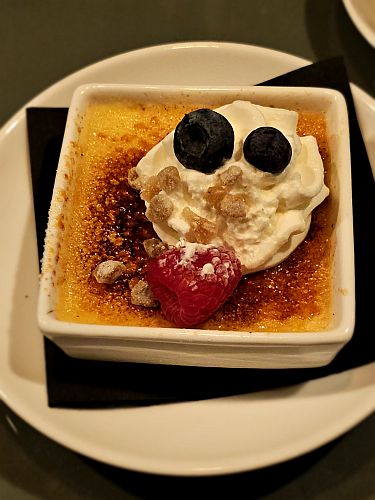
The first, in Pellston, was at the Douglas Lake Bar & Steakhouse. After a very strong Manhattan and a splendid filet of walleye swimming in white sauce (I’ll spare you, dear reader, the “white food” jokes), the crème brûlée was disappointing. The brûlée was thicker than my 2-mm glass camera filters and over-burnt. The crème was not too sweet but was thick and pudding-like and so overseasoned with cinnamon (?), nutmeg (?), or mace(?) that it was reminiscent of a crustless pumpkin pie.
The next night, we had dinner at Taste Kitchen in Ann Arbor. The meal started out worryingly with a pisco sour that was more like a whiskey sour with pisco substituted for whiskey than the classic Peruvian/Chilean cocktail. But my meal of mussels and duck tacos more than made up for the slow start. The lemon-ginger crème brûlée landed somewhere in between. The brûlée was light and nicely crisped, but uneven or missing at some of the corners. Candied ginger was folded into the brandied whipped cream, and fresh raspberries and blueberries completed the unnecessary toppings. The crème custard was much better than I’d had in Pellston, but it still was a little too thick, overly sweet, and on its way to pudding-ness. The take-home from three crème brûlées in a Michigan summer is, “when in Michigan, stick to cherry pie and bumpy cake” (just Google it).

 The Unbalanced Ecologist
I’ve missed you! And your blog too!💗
LikeLike