
DoubleTake is a collaboration with Eric Zeigler. Ten selections from the project are shown here.

Utility Right-of-Way with Wildfire Smoke, W. K. Kellogg Experimental Forest, Augusta, Michigan (2023) 
Fire Remnant in Stand of Red Pines (Pinus resinosa), Huron Mountain Wildlife Foundation, Big Bay, Michigan (2023) 
Welwitschia mirabilis, Welwitschia Plains, Namib Desert, Namibia (2023) 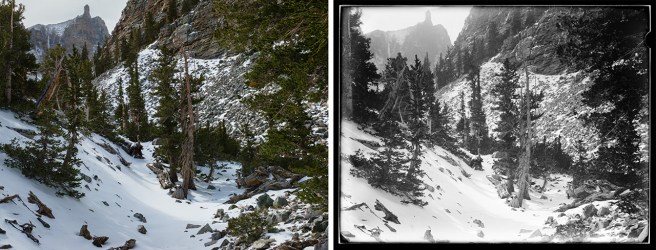
Promontory (diptych), Wheeler Peak Bristlecone Pine Grove, Great Basin National Park, White Pine County, Nevada (2021) 
Log Jam with Carnivorous Plants (diptych), Huron Mountain Wildlife Foundation, Big Bay, Michigan (2023) 
Charred Snags after the 2013 Black Fire, Great Basin National Park, Nevada (2021) 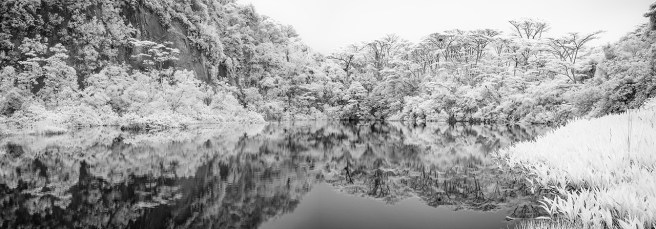
Eagle’s Nest, Restored Quarry at Diary Farm Park, Singapore (2023) 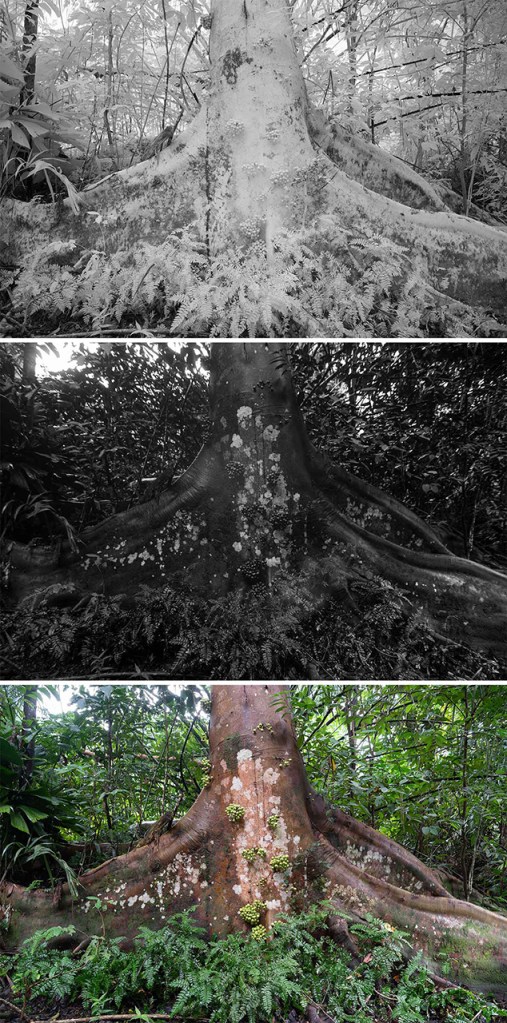
Lichens (triptych), Dairy Farm Park, Singapore (2023) 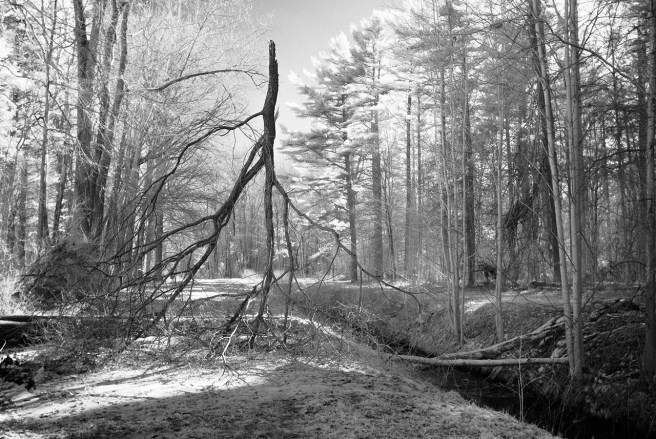
Flipped Tree-Top, Maumee State Forest Stewardship Trail, Swanton, Ohio (2021) 
Divergence II (Succession), Natur-Park Schöneberger Südgelände, Berlin (2023)
Individual images from the DoubleTake project have been exhibited in juried and solo shows in North America and the Republic of Korea. Copies of the full DoubleTake portfolio are in the collections of the Griffin Museum of Photography (Winchester, Massachusetts, USA) and the Czong Institute for Contemporary Art (Gimpo City, Republic of Korea). Some of the images from DoubleTake are included in our photobook, instability.
Artist statement
Imaging devices record single glances of the world—Crack!—trees fall, shutters snap, photographs are captured. But the experience of repeated glances made while moving through the world overtakes the apparent simplicity or objectif-icity of our vision systems. We are constrained by what our brains interpret as “color.” Photographic technology brings different constraints, but our expectations for how we see with our eyes are automatically, and mistakenly, applied to the images we see.
The unique aesthetic qualities of 19th-century photographs printed from collodion dry-plate negatives reinforced contemporary assumptions about landscape and evoked excitement for exploration just as the “frontier” was closing. Glass-plate photography, associated with geological surveys and the nascent transcontinental railroad, conveyed through its limited spectral range (near-ultraviolet to yellows) supported the notion that the West remained an unpopulated terra nullius. These photographs helped to convince the European colonists and their descendants that Native peoples–even when they were included in the images–were but monuments to the past, like the massive cliffs and boulders dotting the vast landscape, all on their way out as the lands were “open for business.”
We re-use the same 19th-century photographic materials along with new digital technologies seeing into the infrared and ultraviolet to evoke similar contradictions in 21st-century narratives of preservation and Earth’s sixth mass extinction. We reclaim the aesthetics behind the myth of the “American Frontier” to record modern ecosystems deemed healthy only because we’ve left them alone. The economic progress flowing from the Industrial Revolution has, ironically, created the context for preservation of “old-growth” forests–tiny islands of “nature” within the vast ocean of unchecked “development.” Like Indigenous reservations, old-growth reserves are akin to botanical gardens or theme parks: they point to an ideal while decaying before our eyes.
Back to Photography portfolios
Last updated 26.VI.2024
 The Unbalanced Ecologist